Sunday, March 11, 2012

Why Make Dolls?

Because I like to make people smile.

Covered in dolls
That sounds kind of pageant-y, but the real answer is not too far off.

My own childhood relationship with dolls was a little rocky.  When I was 6, in 1971, I took one of my dolls to school because all the other girls brought dolls to school.  One girl, seeing my doll, announced, "Yours is different."  She did not say it in a mean-spirited way, but I took it to be something bad and I never brought another doll to school.  My doll was brown, just like me.

My daughter, thankfully, has no such baggage and loves dolls, starting with Dolly, whose travails were the subject of this post.   She has dolls all over her room now.  When she was about five years old, she asked me if I could make her a doll.  Clearly, since I could make quilts and Halloween costumes, a doll was within my capabilities, according to five-year-old logic.

Unfortunately, when it came to doll-making, I had five-year-old skills at that time.  I had a hard time trying to make it all work on my own.  I did not have a mother or grandmother who made dolls for me that I still had as an adult.  It was slow going.  My daughter has all of my sorry first attempts, and she loved them as if they were perfect because her Mommy made them.

It took a couple of years, but I finally worked out a doll that I really liked.    They were brown, just like my sweet daughter.  I took some and a few quilts to sell at a Links Assembly in Detroit in 2010, after considerable prodding by family and friends.

I sold almost all of them, but the best part was the way the women smiled when they saw them.  They thought of their daughters or granddaughters.  They thought of their own fond doll memories.  They looked happy.  And that made me happy, too.  Ecstatic, really.

The dolls are now called Jacq's Girls, named for me (Jacqueline) and my grandfather, Jack, after whom I was named.  My grandfather spoke frequently and proudly about his girls (3 daughters, 6 granddaughters, and 2 great-granddaughters), and these dolls -- along with my own fantastic daughter -- are mine.  And they make me smile.
Jacq's Girls - Chyna

Jacq's Girls - Alyssa
Jacq's Girls - Sydney


Monday, March 5, 2012

It's Doll-Making Time!

You know how you go to Costco and buy a gigantic box of trash bags that lasts for years and you forget that the box isn't really bottomless until you finally, finally reach in there and there is nothing?  And there's that feeling of, "When did I last buy trash bags?"  And you start measuring the time by the ages of your children (I'm pretty sure that was when we bought the fourth Harry Potter book and he was in the fifth grade then...)?

That's pretty much what happened to me.  The last time I dyed I did about 6 yards of fabric.  I had dolls, too, just waiting for loving homes.  I was comfortable.

Then I started looking for a particular shade of fabric and realized I had used it all.  And the dolls were dwindling.  A couple of them looked kind of lonely.

Savannah is smiling on the outside, but inside she misses her friends.


Time to make some girls!  I dyed almost 10 yards of fabric and started tracing patterns.


Hang on, Savannah!  More girls are on the way.

Tuesday, February 28, 2012

Things My Father Told Me, part 2

Superchicken and his sidekick, Fred  c.1968


"You knew the job was dangerous when you took it."
Superchicken to his sidekick, Fred.

I heard variations on this from my father a lot.  When I almost failed took calculus in college, I called home for some words of wisdom.  I was doing all of the work but wasn't doing well on tests, the professor wasn't very sympathetic (he told me that I couldn't always get A's and B's), and I was completely stressed out at the prospect of a 4-credit D on my transcript.  My father was many things, but a math whiz wasn't one of them.  He listened to my tearful story and then said, "Calculus, hmmm...well, Jacqueline, it's calculus.  You should have known the job was dangerous when you took it."  

Not what I wanted to hear.  But I worked really hard and got a C as a Christmas present from my professor.  I was thrilled because it wasn't a D.

So, as much as I want to whine about how hard it is to get these illustrations done, I can hear my father's voice telling me that I knew the job was dangerous when I took it.  Not what I want to hear.  But then I get back to work.

Tuesday, February 21, 2012

Introducing Ruby

Years ago, I asked my maternal grandmother how she celebrated Juneteenth when she was growing up.  Juneteenth is celebrated nationwide now, but it started as a Texas holiday commemorating the day in 1865 when the slaves in Texas learned they had been freed.

Gran laughed her lovely, light laugh and told me about going to visit her paternal grandparents in a little town called Littig.  Littig is one of the oldest black communities in Texas.

My great-great grandparents on their farm in Littig
She talked about going to church and having a picnic, and wearing her favorite red overalls.  My Gran was one of the most elegant women I have ever seen, and the image of her as a little girl in red overalls has stuck with me.

That image has inspired me to write a children's book, tentatively titled Ruby in Red.  I plan to have a doll to go with the book.  I have written (and rewritten, and re-rewritten) the text.  That really wasn't so hard.  I have a template for the doll.  That wasn't so hard, either.

Preliminary sketch of Ruby
Pictures, however, that's been a real journey.  I started out wanting to illustrate the book myself with small art quilts, since art quilts is what I do.

It was hard.  I couldn't even start.

I switched to paper collage.  Hard.

Drawing.  Hard.

Asked my husband (also an artist) if he could do it. Hard.

Back to quilts.  Hey, not so hard after all!

Since mid-January I have done 6.  Number 7 is being laid out now.  Onward!


Wednesday, February 8, 2012

Broad Changes: Women of Social Justice

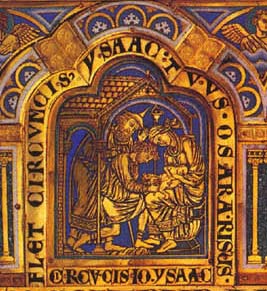
Fiber Artists for Hope is delighted to announce preparations for our next show, to be called Broad Changes: Women of Social Justice.  The organizing committee explains it this way:  the word "broad" is a feisty reference to women and, combined with "changes," it makes a nice double meaning since broad changes can also simply mean big changes.  Each artist will choose a woman or group of women working for social justice about whom to make a piece.

Cirumcision of Isaac
The circumcision of Isaac
Altar of Verdun, 12th century
I am so excited about this topic; the enthusiasm coming from my sister artists is exhilarating!  I plan to blog occasionally about the making of my piece.  It will be about my daughter who, at age 11, isn't exactly a woman, but is awakening to issues of social justice.  Here is the story:

One night my daughter was working on her religion homework, which focused on the Abraham and Isaac story.  She looked up and asked, "Mom, what's circumcision?" I cleared my throat a few times before giving her a very succinct, straightforward answer.  Subject closed?  Ha! You've never met my daughter.

A few minutes later she asked, "They don't do anything like that to girls, do they?"  Deep breaths.  My choices were to either lie and distract her with ice cream, or have a very uncomfortable conversation.  I went with the uncomfortable conversation and presented the information as clinically as possible, with very little editorializing.  She was horrified.  Horrified and kind of freaked out.

Masai girls
She immediately wanted to know what we could do to end this practice.  We talked about building community support and about cultural sensitivity.  We emailed her teacher, who said she had never had a student ask about that.  She was glad though, that we had had a frank discussion, and offered to talk to my daughter about ways she could help; it turns out her teacher used to work with women fleeing this practice.

We sometimes think that children are only interested in themselves, but I think that sells them short.  This issue meant something to her because girls her age and younger are having this done to them.  Now that she is aware of this, she is deeply concerned about the welfare of girls she will probably never meet.

I am so proud of her.  I hope she likes the piece.


Thursday, February 2, 2012

The Pain, the Pain!

I usually have my work flat on the table.  Even though I'm not the tallest person in the world (and soon I will be the shortest person in my house), this has created quite a bit of strain on my neck and shoulders while I am leaning forward over a work.

I thought an easel might do the trick, and went to my favorite art supply store to check out their selection.  Unfortunately, they do not have a section called "Small, inexpensive, tabletop easels that can be oriented upright, horizontally, or somewhere in-between for Jackie."  The young man who helped me was great, as always, and was quite sympathetic about the shoulder pain.  He showed me a couple of stretches that might help.

In the meantime, however, what to do?  Then I remembered the bed trays we got as wedding presents.


I got one down and it fit perfectly on my worktable. It even inclines.


Ta-da!  Less strain means more work.  


Thursday, January 26, 2012

No One Died. I Just Dyed.

I dye the fabric for my dolls' "skin" in my basement.  I started doing it because I couldn't find many solid browns that weren't too gray, or too yellow, or too purple.  I had been hesitant about dyeing my own fabric, but once I got the hang of it, it was easy.  It has even become a joke with my children.  I will say to them, mournfully, "I'm going to the basement to dye."  They put on their sad faces.

Once, my mother-in-law called while I was working and my daughter ran to answer the phone. "Can I tell her you're dyeing?" she asked excitedly, relishing the prospect of a good joke.  My mother-in-law is 82.  No.  Another time I told a friend, without thinking, "I'm down in the basement dyeing.  Can I call you back?"  The absolute silence on the other end of the line gave me enough time to correct myself.  "Dyeing fabric! Not dying!"

Recently I went to the basement to dye, thinking I could do a couple of yards between dinner and falling asleep in front of the TV.  The area I work in has a utility sink, our washer and dryer, a chest freezer, assorted laundry baskets, a rolled-up old cream-colored rug, and -- on this occasion -- my husband's clean dress shirts hanging up over the freezer.  (Do you hear the foreboding music yet?)

Utility sink
Shirts...uh-oh

I use these small plastic containers to mix my dye slurry with a tiny whisk, but I usually end up giving them a quick, vigorous shake just to make sure the dye is completely dissolved. I measured out varying amounts of rust brown, chocolate brown, golden brown, ecru, and water in several of these containers and mixed.  Let's note that both rust brown and chocolate brown contain a lot of red pigment.

Containers for dye slurry
Dye

Tight grip?
And then I gave them all a good shake, checking to make sure the lids were secure.  Plus, I hold them like this to make sure the lids don't fly off.

What happened next was...unexpected.  Mid-shake, I felt liquid on my face.  Running down to my mouth.  I saw liquid the color of dried blood running down the freezer, on the laundry baskets, on my shirt, on the old rug, and on the cuffs of two of my husband's dress shirts. For the record, dye slurry is salty in that split second before you start furiously spitting it out.

And that's when my husband came home -- in the middle of the frantic clean-up -- walking in on what looked like a grisly crime scene.

Not blood on the rug!

I did the best I could with the shirts, but it is fiber-reactive dye.  As long as he keeps his jacket on, you don't see the stains.  That and my shirt are all that still bear the marks of the Massive Dye Accident.  Wearing my not-bloodstained t-shirt is now truly appropriate when I go down to dye.